
11.09.2026
Supercomputers: From Science to Business – Economic Forum in Karpacz
Treść komunikatu
As emphasized during the Economic Forum by Dr. Eng. Robert Sot, Director of the ICM UW, the strategic digital infrastructure of the University of Warsaw is essential not only for the advancement of science but also for social development and applications in the economy and industry: “What we develop at the scientific level, we implement for the benefit of society,” he stated during the Research University debate.
During the 35th Economic Forum in Karpacz (September 8–10), ICM presented its compute infrastructure and digital technology offerings for the modern economy. Held under the theme “Architecture of a New Order – Stability in Times of Change,” the Forum brought together over 6,000 attendees from the worlds of business, politics, and science across more than 500 thematic events.
At the University of Warsaw zone, debates focused on innovation and implementation, business leadership, endowment funds, AI development, and rational public discourse. Dr. Robert Sot joined the panel discussion titled “Research University – Innovation, Implementation, and Social Impact,” moderated by Prof. Zygmunt Lalak, Vice-Rector for Research Organization at UW. The debate also featured Prof. Anna Ajduk (Faculty of Biology), Prof. Renata Włoch (Faculty of Sociology), Prof. Agata Bareja-Starzyńska (Faculty of Asian and African Studies), and Prof. Sławomir Sęk (Faculty of Chemistry).


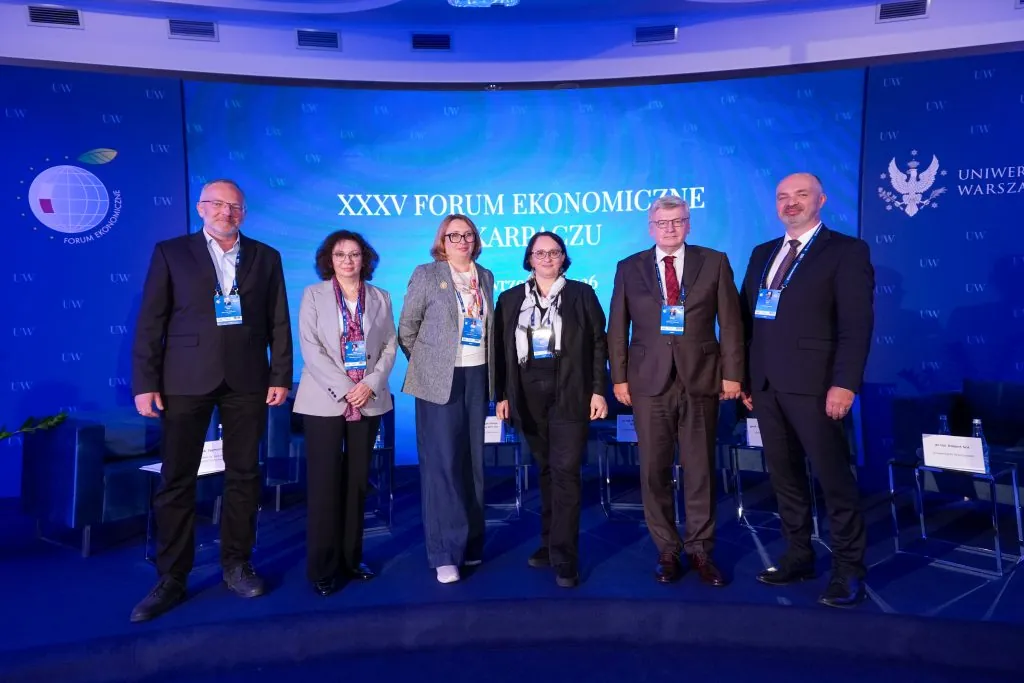
In the context of moving from research to innovation, implementation, and the societal impact of science, Dr. Robert Sot emphasized the importance of interdisciplinary research, the use of mathematical models, advanced computational methods, and data analysis in translating the university’s research potential into practical solutions.
ICM translates this practical dimension of a research university into action across the following areas:
- From Research to Implementation – transitioning from a research project to a concrete application is one of the core elements of ICM’s activities; projects that bridge the gap “from idea to implementation” and commercialize research outcomes include Meteo forecast-based initiatives (SOBEK, LOBSTER, FLOPRES), as well as digital twins of Poland (MAP-tur) and the Baltic Sea (MERMAID);
- Infrastructure as a Prerequisite for Innovation – from ICM’s perspective, a research university requires not only researchers and grants, but also computational infrastructure that enables large-scale research, including studies related to AI and GenAI; therefore, alongside its existing e-infrastructure, ICM is also developing new investments, such as the National Cloud Infrastructure for Open Science (PLGrid ICON) and Secure Quantum Communication (Pionier-Q);
- HPC Services for Business and Science – ICM offers access to HPC computing power, pilot deployments of HPC services, high-performance computing consulting, modeling of complex processes, large-volume data storage, and expert support. The offering also includes analyzing the digital needs of enterprises and consulting in artificial intelligence—including the application of machine learning, deep learning, natural language processing, image analysis, time series, and medical data.
Explore collaboration opportunities with ICM.
